30 Sept 2026
RRB Paramedical Syllabus & CBT Exam Pattern 2026 – All 9 Posts | CEN 05/2026
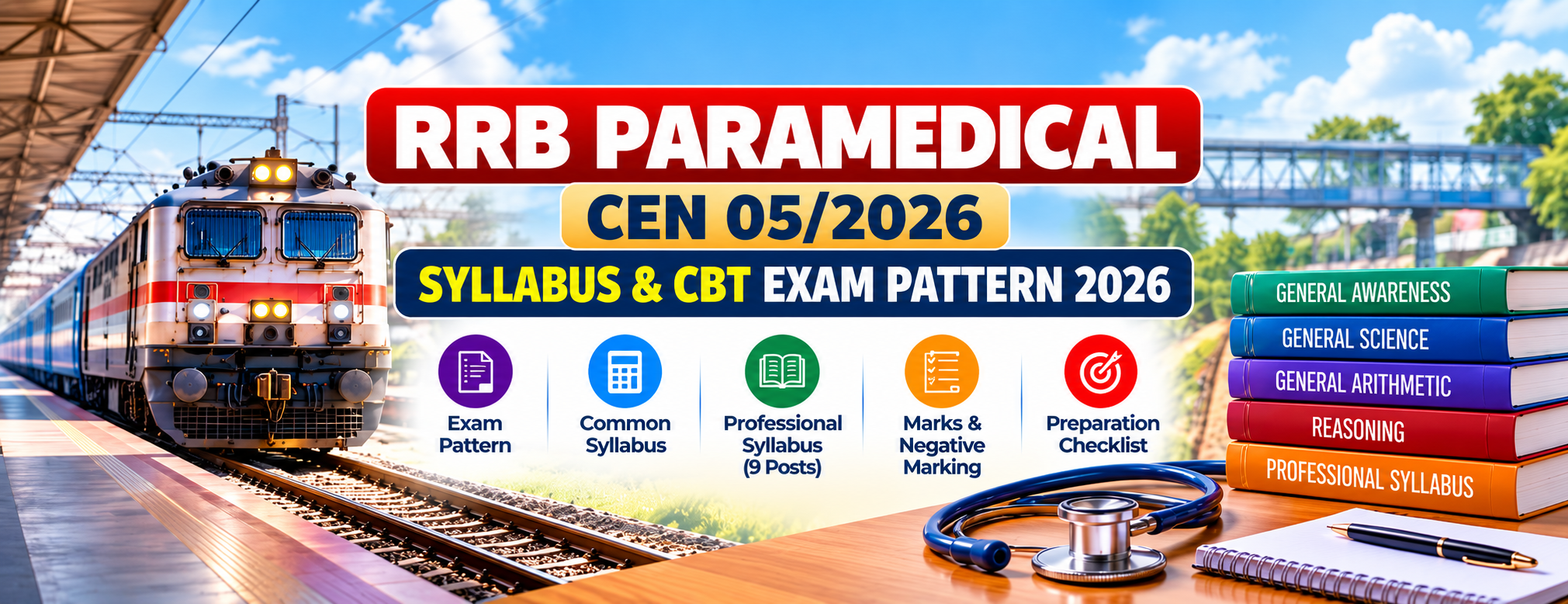
RRB Paramedical Syllabus & CBT Exam Pattern 2026
RRB Paramedical CEN 05/2026 includes a Single Stage Computer Based Test (CBT) covering Professional Ability along with General Awareness, General Arithmetic, General Intelligence & Reasoning and General Science.
Candidates preparing for the notified paramedical categories should understand both the common CBT structure and the Professional Ability syllabus applicable to their post.
This article provides the RRB Paramedical CBT exam pattern, common-section preparation scope and a post-wise overview of the Professional Ability syllabus under CEN 05/2026.
1. RRB Paramedical CBT Exam Pattern 2026
The Single Stage Computer Based Test is objective in nature.
The section-wise distribution given in CEN 05/2026 is indicative, and the official notification states that the question paper may vary.
Professional Ability
Questions : 70
Marks : 70
General Awareness
Questions : 10
Marks : 10
General Arithmetic + General Intelligence & Reasoning
Questions : 10
Marks : 10
General Science
Questions : 10
Marks : 10
Total Questions : 100
Total Marks : 100
Exam Duration : 90 minutes
Duration for scribe-eligible PwBD/PWD candidates : 120 minutes
Negative Marking : 1/3 of the marks allotted for each wrong answer
2. Common Sections in RRB Paramedical CBT
In addition to Professional Ability, candidates have to prepare the common sections included in the CBT.
The common sections are:
• General Awareness
• General Arithmetic
• General Intelligence & Reasoning
• General Science
The indicative CBT pattern assigns a combined 30 questions to these common sections.
Candidates should refer to the detailed CEN 05/2026 for the prescribed common-section syllabus and check subsequent RRB notices for any amendments or exam updates.
3. Post-Wise Professional Ability Syllabus
The Professional Ability syllabus differs according to the paramedical category for which the candidate is appearing.
The following are the syllabus areas included in the supplied syllabus guide.
a. Nursing Superintendent
• Anatomy
• Physiology
• Nutrition
• Biochemistry
• Nursing Foundations
• Psychology
• Microbiology
• Sociology
• Pharmacology
• Pathology
• Genetics
• Medical-Surgical Nursing
• Community Health Nursing
• Child Health Nursing
• Mental Health Nursing
• Midwifery & Obstetrical Nursing
• Nursing Research & Statistics
• Management of Nursing Services and Education
• Professional Trends and Adjustment
b. Pharmacist (Entry Grade)
• Human Anatomy and Physiology
• Pharmaceutical Analysis
• Pharmaceutics
• Pharmaceutical Inorganic Chemistry
• Remedial Biology/Remedial Mathematics
• Pharmaceutical Organic Chemistry
• Biochemistry
• Pathophysiology
• Computer Applications in Pharmacy
• Environmental Sciences
• Physical Pharmaceutics
• Pharmaceutical Microbiology
• Pharmaceutical Engineering
• Medicinal Chemistry
• Pharmacology
• Pharmacognosy and Phytochemistry
• Industrial Pharmacy
• Pharmaceutical Jurisprudence
• Herbal Drug Technology
• Biopharmaceutics and Pharmacokinetics
• Pharmaceutical Biotechnology
• Quality Assurance
• Instrumental Methods of Analysis
• Pharmacy Practice
• Novel Drug Delivery System
• Biostatistics and Research Methodology
• Social and Preventive Pharmacy
• Pharma Marketing Management
• Pharmaceutical Regulatory Science
• Pharmacovigilance
• Quality Control and Standardization of Herbals
• Computer Aided Drug Design
• Cell and Molecular Biology
• Cosmetic Science
• Experimental Pharmacology
• Advanced Instrumentation Techniques
• Dietary Supplements and Nutraceuticals
c. Health & Malaria Inspector Grade II
• Food & Nutrition
• Environmental Sanitation
• Communicable Diseases
• Non-Communicable Diseases
d. Audiologist & Speech Therapist
• Speech and Language Development & Disorders
• Basic Anatomy & Physiology related to Speech & Hearing
• Diagnostic & Rehabilitation Audiology
• Psychology related to Speech & Hearing
• Basic Acoustic
• Pathology of Hearing and Hearing System
• Phonetics + Phonology Electives
• Speech Language Diagnostics and Therapeutics
• Paediatric Audiology
• Management of the Hearing Impaired
• Voice & Laryngectomy
• Hearing Conservation
• Aural Rehabilitation & Its Instrumentation
e. Radiographer X-Ray Technician
• Human Anatomy & Physiology
• Radiology Physics
• General Physics
• Radiation Physics & Physics of Diagnostic Radiology
• X-Ray Machines & Accessories
• Maintenance
• X-Ray Film / Image Processing Techniques (Dark Room Techniques)
• Clinical Radiography - Positioning
• Medical Ethics and Patient Care
• Principles of Medical Emergencies
• Equipments
• Techniques of Modern Imaging Modalities
• Contrast & Special Radiography Procedures
• Quality Control at Radiology & Radiation Safety
f. ECG Technician
• Anatomy
• Physiology
• Biochemistry
• Pharmacology
• Introduction to Cardiovascular Diseases
• Basic Cardiovascular Investigations
• Advanced Cardiovascular Investigations
g. Optometrist
• Physical and Geometrical Optics
• General Anatomy and General Physiology
• Ocular Anatomy and Ocular Physiology
• Basic Biochemistry
• Nutrition
• Principles of Lighting
• Hospital Procedures
• Optometric Optics
• Ocular Diseases
• Visual Optics
• Pharmacology
• Pathology and Microbiology
• Optometric Instruments
• Clinical Examination of Visual System
• Clinical Psychology
• Clinics
• Binocular Vision
• Glaucoma
• Low Vision Aids
• Dispensing Optics
• Pediatric Optometry and Geriatric Optometry
• Contact Lens
• Law & Optometry and Occupational Optometry
• Systemic Diseases
• Epidemiology and Bio Statistics
• Public Health and Community Optometry
h. Laboratory Assistant Grade II
• Anatomy
• Physiology
• Biochemistry
• Fundamentals of Medical Laboratory Technology
• Microbiology
• Clinical Biochemistry
• Pathology & Histopathology
• Haematology and Blood and Bank
4. Important Note About the Syllabus
RRB provides Professional Ability syllabus headings for the respective paramedical categories.
Candidates should prepare the Professional Ability syllabus applicable to their post along with the common CBT sections.
The section-wise CBT distribution is indicative, and candidates should not treat the indicated number of questions as a guaranteed fixed distribution in the actual examination.
5. How to Prepare for the RRB Paramedical Syllabus
Candidates should first identify the Professional Ability syllabus applicable to their post and build their preparation around it.
Professional Ability is the largest indicated section of the CBT, with 70 questions and 70 marks.
However, the common sections should not be ignored.
Candidates should:
• Complete the Professional Ability syllabus applicable to their post
• Practise the common CBT sections regularly
• Keep track of the 90-minute examination duration
• Practise objective questions under timed conditions
• Account for 1/3 negative marking while practising
• Revise weaker syllabus areas regularly
• Check subsequent RRB notices for amendments and examination updates
6. Quick Summary
Recruitment : RRB Paramedical CEN 05/2026
Exam Mode : Computer Based Test (CBT)
Total Questions : 100
Total Marks : 100
Duration : 90 Minutes
Professional Ability : 70 Questions / 70 Marks
General Awareness : 10 Questions / 10 Marks
General Arithmetic + General Intelligence & Reasoning : 10 Questions / 10 Marks
General Science : 10 Questions / 10 Marks
Negative Marking : 1/3 of the marks allotted for each wrong answer
Professional Ability Syllabus : Post-specific
7. Frequently Asked Questions
i. What is the RRB Paramedical syllabus for 2026?
RRB Paramedical CEN 05/2026 includes a post-specific Professional Ability syllabus along with the common CBT sections of General Awareness, General Arithmetic, General Intelligence & Reasoning and General Science. Candidates should prepare the Professional Ability syllabus prescribed for their respective paramedical category.
ii. How many questions are there in the RRB Paramedical CBT?
The indicative CBT pattern contains 100 questions carrying 100 marks. Professional Ability accounts for 70 questions, while the common sections together account for 30 questions. The official notification states that the section-wise distribution is indicative and the actual question paper may vary.
iii. What are the common subjects in the RRB Paramedical exam?
The common sections are General Awareness, General Arithmetic, General Intelligence & Reasoning and General Science. These are included in addition to the post-specific Professional Ability section.
iv. Is there negative marking in the RRB Paramedical CBT?
Yes. There is negative marking of 1/3 of the marks allotted for each incorrect answer.
v. Is the Professional Ability syllabus the same for all RRB Paramedical posts?
No. The Professional Ability syllabus is post-specific. Candidates should prepare the syllabus prescribed for their respective paramedical category under CEN 05/2026.
8. Official Source
The syllabus and CBT information in this article is based on Railway Recruitment Boards CEN 05/2026, Recruitment of Paramedical Categories, including Annexure C.
Candidates should refer to the official CEN and subsequent RRB notices for amendments, examination schedules and other updates.
Official RRB Website :
rrb.indianrailways.gov.in